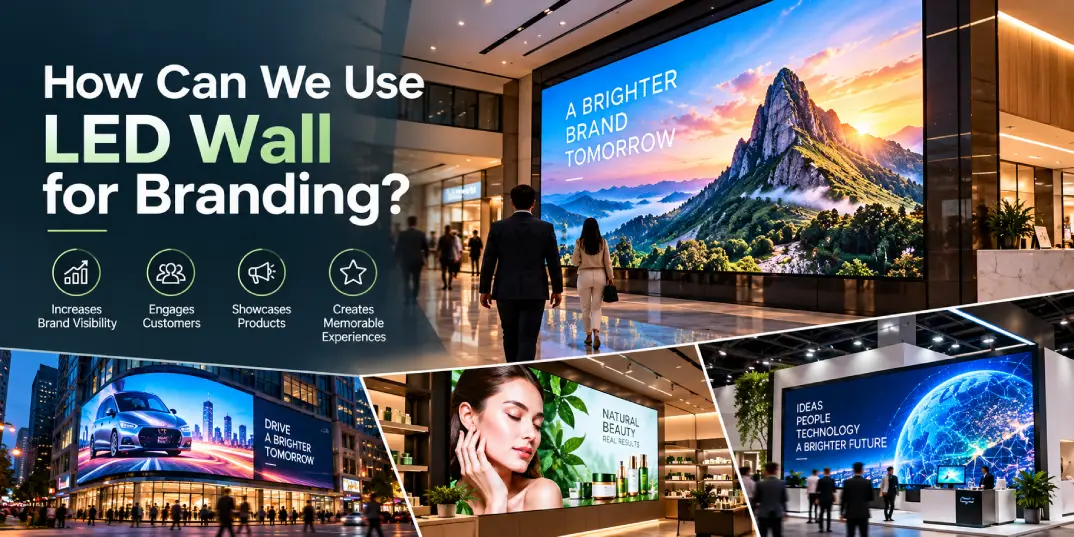
In today's competitive business environment, getting noticed is only half the battle. The real challenge is making your brand memorable. Customers see countless advertisements, promotional banners and social media campaigns every day, so businesses need creative ways to stand out and communicate their message effectively.
This is where an LED wall for branding can make a difference.
LED walls transform ordinary spaces into dynamic visual experiences. Instead of relying solely on static signs or printed posters, businesses can display high-quality videos, animated graphics, product demonstrations, promotional messages and brand stories on large digital screens.
From retail stores and shopping malls to corporate offices, exhibitions and outdoor advertising spaces, LED video walls give businesses new ways to connect with their audiences.
But how can you use an LED wall effectively for branding? Let's explore ten practical ideas and the important factors to consider before investing in one.
What Is an LED Wall, and How Does It Help in Branding?
An LED wall is a large digital display made up of LED modules or panels that work together to create a single viewing surface. Depending on the application, it can be installed indoors or outdoors and configured in different sizes and layouts.
Unlike traditional printed signage, an LED display can showcase moving visuals, videos, animations and frequently updated messages.
For branding, this flexibility offers several advantages:
- Greater visual impact: Bright colours and moving visuals can attract attention in busy environments.
- Consistent brand presentation: Logos, colours, typography and brand messaging can be displayed consistently.
- Flexible content: Businesses can change promotional campaigns without replacing printed material.
- Better storytelling: Videos and animations help explain products, services and brand values.
- Versatile applications: LED walls can be used across retail spaces, corporate environments, events and public-facing locations.
However, the impact of an LED wall depends on more than its size or brightness. The right location, relevant content and a clear branding objective are equally important.
10 Ways to Use LED Walls for Branding
1. Create a Strong First Impression at Your Business Entrance
Your entrance is often the first physical interaction customers have with your brand. An LED wall can turn that space into a memorable introduction to your business.
For example, a hotel can display its welcome message and hospitality experiences, while a car showroom can showcase new models through high-quality videos. A retail outlet can feature seasonal collections, new arrivals and promotional campaigns.
The screen can also display your brand logo, tagline and signature visuals.
Branding tip: Keep the opening visual simple and recognisable. A clear logo, distinctive colours and one strong message will often work better than a screen filled with too much information.
2. Use LED Walls for Retail Store Branding
Retail is one of the most practical environments for LED video wall branding. Customers often make purchase decisions based on product presentation, visual appeal and the experience a store creates.
An LED wall can showcase products in action, introduce new collections, communicate offers and establish the atmosphere of a store.
For example:
- A fashion retailer can display collection launches and styling videos.
- An electronics showroom can demonstrate product features.
- A jewellery store can use elegant product visuals to reinforce its premium positioning.
- A supermarket can highlight seasonal products and promotional offers.
The key is to match the content to the customer's shopping journey. An attractive screen near the entrance may introduce a campaign, while a display near a product category can provide useful product information.
3. Strengthen Your Corporate Office Branding
Branding is not limited to customers. Employees, job applicants, investors, business partners and visitors also form opinions about a company from its physical environment.
An LED wall in the reception area can communicate a company's identity, mission, achievements and areas of expertise.
Businesses can use corporate LED displays to showcase company milestones, project highlights, team achievements, sustainability initiatives and welcome messages for important visitors.
In meeting rooms and boardrooms, LED walls can also support presentations, product demonstrations and corporate events.
Why it works: Instead of treating office branding as decoration, businesses can use digital displays to make their identity visible throughout the workplace.
4. Make Exhibitions and Trade Show Stalls Stand Out
At exhibitions and trade shows, multiple brands compete for attention within the same space. A well-designed LED video wall can help your stall attract visitors and communicate your value proposition quickly.
You can use it to display:
- Product demonstrations and explainer videos.
- Brand introductions and company capabilities.
- Client project highlights and case studies.
- Animated product features.
- Live presentations and event coverage.
For example, a technology company exhibiting at an industry event can run a short product demonstration that visitors understand even before speaking to the sales team.
Remember that the screen should support your stall's message, not overwhelm it. Combine engaging visuals with a clear headline, a concise value proposition and an easy next step, such as visiting a demonstration area or scanning a QR code.
5. Promote Your Brand During Corporate Events and Product Launches
Product launches, conferences, annual meetings and dealer events provide excellent opportunities for LED wall branding.
A large LED display can serve as the main stage backdrop, displaying the event identity, speaker names, product visuals, presentations and live camera feeds.
For a product launch, the screen can reveal the product through an animation, present its key features or show how it solves a customer problem.
For corporate events, branded transitions and consistent visual templates can make the overall experience feel more professional.
LED walls can also support sponsor recognition by giving event partners designated screen time.
To get the best result, prepare the content in advance and test the resolution, aspect ratio, playback system and screen layout before the event begins.
6. Increase Brand Visibility with Outdoor LED Advertising
Outdoor LED displays can help businesses communicate with audiences in high-traffic commercial areas, shopping districts and suitable public-facing locations.
They can be used for brand awareness campaigns, product announcements, store promotions and time-sensitive advertising.
Unlike a static billboard, an outdoor LED display can show multiple approved creatives over a scheduled period. This allows brands to adapt messaging for different campaigns without physically replacing the entire display.
For example, a restaurant might promote its lunch menu during the day and highlight its evening dining experience later.
Location matters just as much as the display itself. Consider audience movement, viewing distance, visibility, surrounding light conditions and the time available to read the message.
Outdoor installations should also meet applicable structural, electrical, advertising and local authority requirements.
7. Build a Premium Brand Experience in Malls and Showrooms
Shopping malls, automobile showrooms, experience centres and premium retail spaces can use LED walls to make brand communication more immersive.
Instead of displaying only product photographs, businesses can create visual stories around product design, lifestyle, craftsmanship or customer experiences.
A real estate showroom, for instance, can use an LED wall to present property walkthroughs, architectural visualisations and project amenities. A furniture showroom can show products in different interior settings, helping customers imagine how they might look in their own homes.
The objective is to make the brand experience more informative and engaging, rather than simply making the space look impressive.
8. Tell Your Brand Story Through Video Content
People connect with stories more easily than with a series of disconnected promotional messages.
An LED wall gives businesses a large canvas to communicate what they do, why they do it and what makes them different.
A brand story might include:
- The problem the business set out to solve.
- How its products or services help customers.
- The people and expertise behind the business.
- Customer experiences or project highlights.
- The brand's vision for the future.
For instance, a manufacturing company could display its production process, quality checks and product applications. A hospitality brand could show the guest experience from arrival to departure.
Keep the story authentic and specific. Genuine footage, clear narration and relevant visuals are generally more useful than generic animations that could represent any company.
9. Use Interactive Content to Encourage Customer Engagement
Some digital display environments can be integrated with interactive kiosks, touch-enabled systems, QR codes and other digital tools.
These features can help customers move beyond simply watching an advertisement.
Depending on the system, a brand might let visitors explore product specifications, browse available options, access a catalogue, register for an event or participate in a campaign.
For example, an exhibition visitor could scan a QR code displayed on an LED wall to access a product brochure or request a demonstration.
Not every LED wall supports touch interaction directly, so businesses should distinguish between an ordinary LED video wall and a complete interactive display setup.
The best interactive campaigns have a clear purpose and make the next action easy for the customer.
10. Keep Branding Consistent Across Multiple Locations
Businesses with several branches, showrooms or offices can use connected digital signage systems to maintain consistent brand communication.
A central content management system, where supported, can help authorised teams schedule campaigns, update promotional creatives and coordinate messaging across multiple screens.
For example, a retail chain can launch a new campaign across participating outlets while allowing individual locations to display relevant local information.
This can simplify campaign management and reduce the need to replace printed signage repeatedly.
Before implementation, check whether the display hardware and software support centralised management, user permissions, scheduling and reliable connectivity.
How to Choose the Right LED Wall for Your Branding Needs
Choosing the right LED wall starts with the intended use, not simply the available budget.
Indoor vs. Outdoor LED Walls
Indoor LED walls are generally designed for controlled lighting conditions and closer viewing distances. They are commonly used in stores, showrooms, reception areas, conference rooms and exhibition halls.
Outdoor LED walls need to handle sunlight, changing weather and environmental exposure. Brightness, weather protection and installation safety are particularly important.
Choose a display according to where it will operate and how people will view it.
Resolution and Pixel Pitch
Pixel pitch refers to the distance between the centres of neighbouring LED pixels. A smaller pixel pitch generally provides greater detail at closer viewing distances, while the appropriate choice depends on screen size, content and audience position.
A screen designed for viewing from across a large outdoor space may have different requirements from one installed behind a reception desk.
Screen Size and Placement
The largest possible screen is not necessarily the most effective one. Consider the available space, sightlines, viewing distance and the way people move through the area.
The screen should be noticeable without interfering with navigation, other signage or the overall design of the environment.
Content Quality and Brand Consistency
Even a technically excellent LED wall will deliver a weak branding experience if the creative content is poor.
Use clear messaging, high-quality visuals, readable typography and consistent brand colours. Make sure videos are prepared for the screen's actual resolution and aspect ratio.
Avoid overcrowding the display with multiple messages, small text or excessive animation.
Installation, Maintenance and Total Cost
Your budget should account for more than the display panels. Installation structure, electrical infrastructure, controller hardware, software, content production, servicing and future component replacement may also contribute to the total cost.
Ask about warranty coverage, maintenance access, spare parts and technical support before making a decision.
Best Practices for Successful LED Wall Branding
To get more value from your LED display, keep these practical principles in mind.
Start with one clear objective. Decide whether the screen should increase brand awareness, support a product launch, improve the customer experience or encourage enquiries.
Match content to the location. A retail entrance, corporate reception and outdoor advertising site serve different audiences and require different messages.
Keep visuals simple. Use a recognisable brand identity and communicate one main idea per creative.
Refresh content regularly. Update campaigns to reflect new products, seasonal occasions, events and changing business priorities.
Measure the results. Track relevant indicators such as campaign reach where available, QR code scans, event enquiries, offer redemptions, website visits or changes in store traffic. Use the metrics that match your original objective rather than assuming screen exposure automatically creates sales.
Plan for accessibility and safety. Ensure important information is legible, avoid unnecessarily distracting effects and follow installation and electrical safety requirements.
Are LED Walls Worth It for Branding?
An LED wall can be a valuable branding investment when it serves a clear business purpose and is used consistently.
Its main advantage is flexibility. One display can support multiple campaigns, product launches, brand stories and event messages over time. It can also create a stronger visual identity in places where customers, employees or business partners regularly interact with the brand.
However, results depend on several factors, including placement, display quality, creative execution, operating costs and audience relevance. An LED wall is not a substitute for a sound marketing strategy; it is a medium through which that strategy can be delivered.
For businesses that frequently update promotional content or want to create a distinctive physical brand experience, it may be worth evaluating the investment against other available branding channels.
Frequently Asked Questions
1. How can an LED wall help with branding?
An LED wall helps businesses display logos, videos, product promotions, brand stories and campaign messages through dynamic visual content. It can improve brand visibility and create more engaging customer experiences when used in the right location.
2. Where can LED walls be used for brand promotion?
LED walls can be used in retail stores, shopping malls, corporate offices, reception areas, showrooms, exhibitions, conferences, product launches and suitable outdoor advertising locations.
3. Are LED walls better than traditional signboards?
LED walls offer dynamic content, flexible updates and video capabilities, while traditional signboards can be simpler and more economical for permanent messages. The better option depends on your campaign objectives, budget and how often the content needs to change.
4. Can small businesses use LED walls for branding?
Yes. Small businesses can consider appropriately sized LED displays for storefronts, reception areas, showrooms and promotional spaces. The display should fit the available budget and audience needs rather than being selected purely for size.
5. What content should be displayed on an LED wall?
Suitable content includes short promotional videos, product demonstrations, brand stories, campaign announcements, customer testimonials, event information and clear calls to action. Content should be relevant to the audience and adapted to the display's dimensions.
6. How can businesses measure the effectiveness of LED wall advertising?
Businesses can measure results using relevant indicators such as QR code scans, campaign-specific website visits, enquiries, offer redemptions and changes in footfall. Where reliable audience measurement is available, it can also help estimate exposure.
LED walls offer businesses a flexible way to bring branding to life. From creating a memorable entrance and improving retail presentation to supporting exhibitions, product launches and outdoor campaigns, they can make brand communication more visual and adaptable.
The most effective approach is to combine the right display technology with meaningful content, strategic placement and consistent brand messaging.
Rather than investing in an LED wall simply because it looks impressive, identify what you want your audience to see, remember or do. Then choose a display solution that supports that goal.
When technology and creative strategy work together, an LED wall becomes more than a screen. It becomes an active part of the brand experience.
Contact Fiable Creations for LED Wall related enquiries.