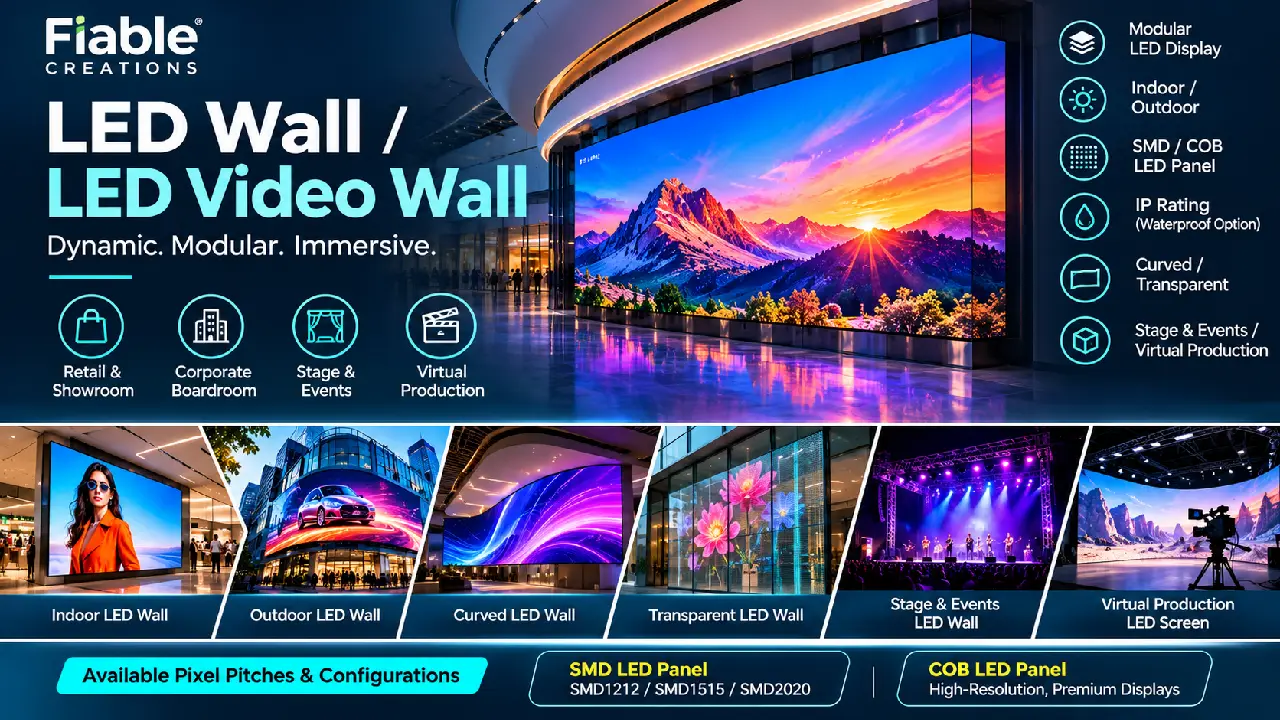
Visual communication has become an important part of modern business, advertising and entertainment. Whether a company wants to promote its products, create an impressive showroom, deliver a corporate presentation or organise a large event, the quality of its display technology can make a significant difference.
This is where an LED Wall or LED Video Wall becomes valuable.
An LED wall is a large-format digital display made by combining multiple LED modules or panels to create a seamless visual surface. It can display high-resolution images, videos, animations, advertisements and live content across different environments.
From indoor retail displays and corporate boardrooms to outdoor advertising screens, concert stages and immersive 3D installations, LED video walls provide flexible ways to communicate with audiences.
Modern LED display technology also offers several configurations, including modular LED displays, SMD and COB panels, curved LED walls and transparent LED screens.
But which type of LED wall is suitable for your business?
In this guide, we explore LED wall technology, its different types, important specifications, applications and factors to consider before selecting an LED display.
What Is an LED Wall or LED Video Wall?
An LED wall is a large digital display system made up of multiple LED panels or modules connected together to form a larger screen.
Each LED module contains light-emitting diodes that produce images and videos through a combination of red, green and blue light.
These modules are assembled into cabinets or panels, which can be connected in different configurations depending on the required screen dimensions and installation environment.
An LED video wall offers several advantages:
- Large, seamless display surfaces.
- Bright and vibrant visual output.
- Flexible screen dimensions and configurations.
- Support for video, animation and live content.
- Customisable installation options.
- Applications across indoor and outdoor environments.
- Options for curved and creative display structures.
Unlike conventional display screens, modular LED walls can be designed for large installations where a standard television or monitor would not be practical.
Different Types of LED Walls and LED Displays
LED display technology is available in several configurations. The right option depends on the intended application, viewing distance, environment and visual requirements.
1. Indoor LED Wall
An indoor LED wall is designed for controlled indoor environments such as shopping malls, showrooms, corporate offices, conference rooms and exhibition halls.
These displays are commonly selected for applications where viewers may stand relatively close to the screen and detailed visuals are important.
Typical applications include:
- Retail stores and shopping malls.
- Hotel lobbies and reception areas.
- Corporate boardrooms.
- Exhibition and conference venues.
- Restaurants and hospitality spaces.
- Indoor advertising installations.
Indoor LED screens should be selected according to the room's lighting conditions, viewing distance and required pixel pitch.
2. Outdoor LED Wall
An outdoor LED wall is designed for installations exposed to sunlight, dust, rain and changing environmental conditions.
These displays are commonly used for advertising, public information and large-scale visual communication.
Popular applications include:
- Building facades.
- Roadside advertising.
- Shopping centres.
- Stadiums.
- Public gathering spaces.
- Outdoor event stages.
- Commercial building signage.
Outdoor LED displays generally require higher brightness and appropriate environmental protection.
When purchasing an outdoor LED video wall, pay close attention to its IP protection rating, cabinet construction, brightness, ventilation and electrical safety.
A display should never be considered waterproof simply because it is described as an outdoor LED screen. Verify the actual protection rating for the installation conditions.
3. Modular LED Display
A modular LED display is constructed using individual LED modules and cabinets that fit together to form a larger display.
This design allows businesses to create screens in different dimensions and aspect ratios.
For example, a retail showroom may require a wide horizontal display, while an event organiser may need a large vertical screen or a stage backdrop.
Modular LED technology provides flexibility in screen design and can also simplify servicing because individual components may be replaced instead of dismantling the entire display.
It is particularly useful for large commercial installations, exhibitions, control rooms and event environments.
4. Digital LED Display Board
A digital LED display board is an electronic screen used to communicate information, advertising and promotional messages.
Businesses can use digital LED display boards to show:
- Promotional offers.
- Product announcements.
- Corporate messages.
- Event schedules.
- Public announcements.
- Brand campaigns.
- Live video content.
Unlike traditional printed boards, digital LED displays can present changing content without requiring a physical replacement of the signage.
They are commonly used in commercial spaces, retail environments, transportation locations and public-facing installations.
Understanding SMD and COB LED Panel Technology
The LED technology used in a display has an important influence on its image quality, durability, maintenance requirements and suitability for different environments.
Two commonly discussed technologies are SMD and COB.
1. SMD LED Panel (Surface-Mounted Device)
SMD stands for Surface-Mounted Device.
In an SMD LED panel, the red, green and blue LED chips are packaged together into a compact component mounted on the display's circuit board.
SMD technology is widely used in indoor and outdoor LED video walls.
Key features include:
- Full-colour display capabilities.
- Wide viewing angles.
- Multiple pixel-pitch options.
- Flexible modular configurations.
- Applications across advertising and commercial displays.
SMD LED panels are suitable for retail signage, outdoor advertising, stage displays, commercial installations and large-format video walls.
Fiable's published Fiabitron LED video wall specifications include SMD configurations such as SMD1212, SMD1515 and SMD2020 across different pixel pitches.
2. COB LED Panel (Chip on Board)
COB stands for Chip on Board.
In COB technology, multiple LED chips are mounted directly onto a substrate and protected using an encapsulation layer.
This creates a compact display structure and can offer additional protection for the LED surface.
Potential advantages include:
- A more integrated LED surface.
- Protection against routine surface contact.
- High-resolution indoor display possibilities.
- Suitable configurations for close-viewing applications.
- Applications in premium corporate and professional environments.
COB technology is often considered for fine-pitch displays, control rooms, premium boardrooms and environments where viewers are close to the screen.
SMD vs COB: Which One Should You Choose?
Both technologies have their own advantages.
SMD offers versatile applications across a wide range of LED displays, while COB is particularly relevant to certain premium fine-pitch applications.
The right selection depends on pixel pitch, viewing distance, environment, maintenance requirements and total project budget.
It is advisable to compare actual product specifications rather than choosing a display based only on its LED technology label.
Specialised LED Display Solutions
Apart from conventional flat LED screens, businesses can explore specialised display formats for unique architectural, advertising and entertainment applications.
1. Curved LED Wall
A curved LED wall uses compatible flexible or curved display modules and cabinets to create a non-flat display surface.
Depending on the system design, it can be configured in concave, convex, cylindrical or other creative shapes.
Common applications include:
- Retail experience centres.
- Shopping malls.
- Exhibition spaces.
- Hotel lobbies.
- Stage backdrops.
- Architectural installations.
- Immersive brand environments.
Curved LED displays can help businesses create more distinctive visual experiences.
However, the required curvature, cabinet compatibility and installation structure must be planned in advance.
2. Transparent LED Wall
A transparent LED wall is designed to display digital content while allowing some visibility through the screen.
This technology can be particularly useful in commercial spaces where businesses want to display advertisements without completely blocking natural light or the view behind a glass surface.
Typical applications include:
- Shopping mall storefronts.
- Retail glass facades.
- Automobile showrooms.
- Airport terminals.
- Exhibition spaces.
- Commercial building windows.
Transparent LED screens can help businesses turn glass surfaces into digital advertising areas while maintaining a degree of transparency.
Actual transparency, brightness and viewing performance vary by product design and installation conditions.
3. Waterproof LED Screen
A waterproof LED screen is designed with an appropriate level of protection against water and environmental exposure.
Such displays are considered for outdoor advertising, stadiums, public installations and outdoor event environments.
When comparing waterproof LED screens, check:
- Front and rear IP ratings.
- Cabinet sealing.
- Power connection protection.
- Outdoor brightness.
- Ventilation and thermal management.
- Installation and maintenance arrangements.
The required IP rating depends on the location and expected exposure. Always obtain the manufacturer's documented specifications for the complete installed system.
4. 3D LED Video Wall
A 3D LED video wall creates the appearance of depth through carefully designed visual content and display techniques.
Some installations use anamorphic content on specially arranged LED surfaces to create an illusion of objects extending beyond the display.
This can produce visually striking advertising experiences without requiring viewers to wear special glasses.
Common applications include:
- Shopping malls.
- Outdoor advertising.
- Retail showrooms.
- Brand activation campaigns.
- Commercial buildings.
- Entertainment spaces.
- Product launches.
A 3D LED wall combines suitable display hardware with specially produced content. The visual effect depends heavily on the viewing angle, display geometry and creative execution.
Fiable's Fiabitron 3D LED Video Walls are positioned for immersive brand experiences, retail environments, events and commercial installations.
LED Walls for Stage and Events
Stage and event LED walls have become an important part of modern event production.
They provide large visual backdrops for live performances, presentations, ceremonies and entertainment programmes.
Event organisers can use LED video screens for:
- Concerts and music festivals.
- Weddings and celebrations.
- Corporate events.
- Award ceremonies.
- Product launches.
- Exhibitions and trade shows.
- Conferences and seminars.
- Cultural and entertainment programmes.
A stage LED wall can display animations, event branding, speaker presentations, live camera feeds and visual effects.
Rental LED video walls are also available for temporary installations where panels need to be transported, assembled and dismantled regularly.
For event applications, important considerations include brightness, pixel pitch, refresh rate, screen dimensions, structural rigging, weight and content playback compatibility.
Commercial Applications of LED Video Walls
LED walls are no longer limited to entertainment and advertising. They are increasingly relevant across several commercial environments.
1. Retail and Showroom Digital Signage
Retail businesses use LED video walls to improve product presentation and create attractive shopping environments.
A showroom can display product videos, promotional campaigns, new arrivals and brand stories on large digital screens.
Examples include:
- Automobile showrooms displaying vehicle features.
- Fashion retailers showcasing new collections.
- Electronics stores demonstrating products.
- Jewellery showrooms presenting premium collections.
- Furniture stores displaying interior design concepts.
Digital signage can also help businesses update their promotional content according to changing campaigns and offers.
2. Corporate Boardroom LED Display
Corporate boardrooms require professional presentation and communication systems.
A corporate boardroom LED display can be used for presentations, financial reports, strategy discussions, business dashboards and video conferencing.
Large LED walls can also serve as central visual displays in executive meeting rooms and collaborative workspaces.
When selecting an LED display for a boardroom, consider viewing distance, fine pixel pitch, text clarity, colour consistency and compatibility with the organisation's presentation and conferencing equipment.
3. Virtual Production LED Screen
Virtual production uses large LED display environments to present digital backgrounds and visual scenes during film, television and video production.
Instead of relying entirely on traditional green-screen techniques, production teams can film actors in front of LED screens displaying digitally created environments.
Applications include:
- Film production.
- Television studios.
- Commercial advertisements.
- Music video production.
- Virtual sets.
- Extended reality (XR) environments.
For virtual production, the display system requires careful evaluation of pixel pitch, refresh performance, camera synchronisation, colour reproduction, brightness and processing capabilities.
Not every LED video wall is suitable for virtual production. It is important to select a system specifically designed and tested for camera-facing applications.
4. LED Walls for Hotels and Hospitality
Hotels, resorts and hospitality businesses can use LED walls to create attractive reception areas, event spaces and guest experiences.
Displays can present welcome messages, event information, promotional content and hospitality branding.
Large screens can also be installed in banquet halls and conference facilities to support events and business gatherings.
5. LED Walls for Control Rooms
Control rooms require displays that can present several sources of information simultaneously.
Large LED video walls can be configured to display dashboards, monitoring systems, maps, live feeds and operational information.
The selection should consider resolution, viewing distance, continuous operation, system redundancy, signal processing and maintenance accessibility.
Important Specifications to Check Before Buying an LED Wall
Choosing an LED display requires more than deciding its physical dimensions.
Here are some specifications buyers should evaluate.
1. Pixel Pitch
Pixel pitch refers to the distance between the centres of neighbouring pixels, generally measured in millimetres.
A smaller pixel pitch generally provides greater image detail at shorter viewing distances.
For example, fine-pitch LED panels may be suitable for boardrooms and indoor showrooms, while larger pixel pitches may work for outdoor displays viewed from further away.
Select the pixel pitch according to the intended viewing distance.
2. Brightness
Brightness is measured in nits or candelas per square metre.
Indoor LED walls generally have different brightness requirements from outdoor LED walls.
An outdoor display may need higher brightness to remain visible under direct sunlight, while a boardroom display may operate in a controlled lighting environment.
3. Refresh Rate
Refresh rate indicates how frequently the display updates its image.
It is generally measured in hertz (Hz).
A suitable refresh rate helps provide smoother visual output and is an important consideration for video playback, cameras and certain professional applications.
4. IP Rating
IP rating indicates the level of protection provided by an enclosure against the entry of solid particles and water.
This is particularly important when purchasing outdoor LED screens.
Check whether the specified rating applies to the front, rear or entire cabinet, and whether it is appropriate for the actual installation environment.
5. Colour Depth and Grey Scale
Colour depth and grey-scale performance influence how smoothly the display reproduces colours and tonal variations.
These factors can be particularly important for premium advertising visuals, professional presentations and high-quality video content.
6. Power Consumption
LED walls can be large installations, so electrical requirements should be considered before installation.
Check maximum and average power consumption, power supply requirements, electrical distribution and cooling arrangements.
7. Maintenance and Warranty
Ask about component replacement, module availability, service access, warranty coverage and technical support.
For large installations, maintenance planning can have a significant influence on long-term operating costs.
How to Choose the Right LED Wall for Your Business
Before purchasing an LED video wall, answer a few important questions:
Where will the display be installed?
Determine whether it will be installed indoors, outdoors, behind glass, on a stage or in a corporate environment.
How far away will viewers stand?
Viewing distance helps determine the suitable pixel pitch and display resolution.
What type of content will be displayed?
Static advertisements, videos, presentations, live camera feeds and virtual production content may have different hardware requirements.
What screen shape is required?
Decide whether a conventional flat display is sufficient or whether you need a curved, transparent or creative LED structure.
What are the installation requirements?
Consider the wall structure, mounting arrangement, electrical supply, ventilation and cable management.
What support is available after installation?
Evaluate warranty coverage, technical assistance, service arrangements and component availability.
Having clear answers to these questions makes it easier to compare different LED display solutions and select the right system.
Why Explore Fiabitron 3D LED Video Walls by Fiable Creations?
Fiable Creations offers Fiabitron 3D LED Video Walls designed for immersive visual experiences across retail, corporate, event and commercial environments.
These large-format displays combine modular LED technology with configurations suitable for different screen sizes and visual applications.
Published Fiabitron specifications include:
- Pixel Pitch Options: 1.5 mm, 1.9 mm, 2.6 mm, 2.9 mm and 3.9 mm.
- SMD LED Configurations: SMD1212, SMD1515 and SMD2020, depending on the selected model.
- Brightness: 2,000 nits or more for selected configurations and 2,500 nits or more for others.
- Refresh Rate: 7,680 Hz as listed in the product specification.
- Grey Scale: 16-bit.
- Modular Design: Configurations using modular panels for larger installations.
- Curved Display Support: Compatible configurations for curved display arrangements.
- Customisation: Display sizes, resolutions and configurations based on project requirements.
Fiabitron 3D LED Video Walls can be considered for retail showrooms, corporate lobbies, events, exhibitions, entertainment venues and selected outdoor display projects.
The right configuration should be determined according to the viewing distance, site conditions, display geometry and intended content.
For outdoor projects, buyers should specifically confirm the weather-protection requirements. Fiable's currently published specification table lists an IP31 rating, so a higher-rated configuration should be verified in writing before specifying a screen for direct exposure to rain or other outdoor conditions.
Explore Fiabitron 3D LED Video Walls:
https://fiablecreations.com/fiabitron-3d-led-video-walls/
Frequently Asked Questions (FAQs)
1. What is an LED video wall?
An LED video wall is a large digital display created by combining multiple LED modules or panels. It is used to display advertisements, videos, presentations, live feeds and other visual content.
2. What is the difference between an LED wall and an LED screen?
An LED screen generally refers to an individual LED display, while an LED wall is typically a larger display surface created from multiple connected LED panels. The terms are also commonly used interchangeably in commercial applications.
3. What is a modular LED display?
A modular LED display consists of individual LED modules and cabinets that can be connected to create larger screens in different sizes and configurations.
4. What is the difference between SMD and COB LED panels?
SMD panels use packaged LED components mounted on a circuit board, while COB panels mount multiple LED chips directly onto a substrate with an encapsulation layer. Both technologies serve different display requirements and applications.
5. What is the difference between indoor and outdoor LED walls?
Indoor LED walls are designed for controlled lighting environments, while outdoor LED walls require appropriate brightness and protection against environmental exposure. The right configuration depends on installation conditions and viewing requirements.
6. Are outdoor LED screens waterproof?
Outdoor LED screens can be designed with water and dust protection, but their actual suitability depends on the documented IP rating and cabinet construction. Buyers should verify the rating for the intended exposure rather than relying only on an outdoor product label.
7. What is a curved LED wall?
A curved LED wall is a display configured with compatible curved or flexible modules to create a non-flat visual surface. It is commonly used in showrooms, exhibitions, stages and immersive installations.
8. What is a transparent LED wall?
A transparent LED wall is a display designed to show digital content while allowing some light and visibility through the screen. It is commonly used in glass storefronts, showrooms and commercial facades.
9. Where are stage LED walls used?
Stage LED walls are used at concerts, weddings, conferences, exhibitions, product launches, cultural events and corporate programmes to display videos, presentations, animations and live content.
10. What is a virtual production LED screen?
A virtual production LED screen is a specialised LED display used to present digital environments and backgrounds during film and video production. It requires suitable pixel pitch, refresh performance, camera synchronisation and colour reproduction.
11. How do I select the right pixel pitch for an LED wall?
Pixel pitch should be selected according to the distance between the screen and its viewers. Smaller pixel pitches generally provide more detailed images at closer viewing distances.
12. Are LED video walls suitable for corporate boardrooms?
Yes. Fine-pitch indoor LED video walls can be used in corporate boardrooms for presentations, business dashboards, collaboration and video conferencing. The screen specification should match the room size and viewing distance.
Conclusion
LED walls are transforming how businesses communicate, advertise and present visual information.
From modular LED displays and SMD or COB technology to curved screens, transparent displays and 3D LED video walls, modern display solutions offer multiple possibilities across different industries.
Retail stores can use LED screens to showcase products, corporate offices can create professional presentation environments, event organisers can build impressive stage backdrops, and production studios can explore specialised virtual production displays.
However, selecting the right LED wall requires careful consideration of pixel pitch, brightness, refresh rate, IP protection, installation requirements and long-term maintenance.
If your business is planning a new digital display installation or exploring immersive visual technology, explore Fiabitron 3D LED Video Walls by Fiable Creations.
Choose the right display technology to make your brand more visible, your presentations more engaging and your visual experiences more memorable.
Fiable Creations – Where Technology Meets Imagination.
Product Enquiries:
Website: https://fiablecreations.com/fiabitron-3d-led-video-walls/
Email: contact@fiablecreations.com
Phone: +91 84472 71340